The greatest threat facing African rhinos today is poaching for the illegal trade in their horns. The illegal trade has soared in recent years. The two African rhino species – black rhino and white rhino continue to be at risk due to a huge surge in poaching to meet the demand for the illegal rhino, primarily in Asia countries.
Rhino horn is predominantly used in traditional Chinese medicine. The horn is also increasingly used as a symbol to display success and wealth.
Let us unite and bring an end to this impunity. Rhino horns must be left to rhinos!
Most African countries have since the COVID-19 outbreak, gone into a complete lockdown which has included the closure of national parks, game reserves, community wildlife management areas, and wildlife sanctuaries to tourism. In many African countries, tourism revenues have gone to zero. For Uganda, on June 1st, 2020, H.E Yoweri Kaguta Museveni, the president of the Republic of Uganda, in his address to the nation, revealed that the country will lose over $1.6 billion due to loss of tourism. This is not good news for wildlife living in Africa!
Many conservation agencies in Africa rely directly on revenue from tourism. The money generated from tourism provides a financial incentive for governments and local communities to protect wildlife. The continued lockdown as a result of COVID-19 has sent many people in Africa back to rural areas which has led to increased pressure on wildlife. There is as a result increased poaching, encroachment, and illegal wildlife trade. In May 2020, Mr. Sam Mwandha, the Executive Director of Uganda Wildlife Authority, in a virtual U.S Congressional Staff Briefing on the COVID-19 impact in Africa, organized by ICCF, revealed that in Uganda, the crimes had increased by about 20% in the previous two months.
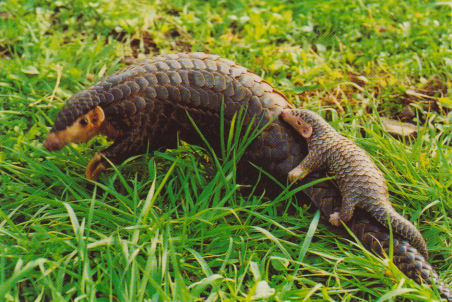
COVID-19 is believed to be the latest catastrophe caused by the illegal wildlife trade. The virus, which was declared a pandemic by WHO, is causing havoc in the whole world. Pangolins, the world’s most trafficked mammals, accounting for over 20% of all illegal wildlife trade, are a prime suspect for the cause of COVID-19.
Together, we can put an end to poaching and illegal trade of wildlife for food, medical value, as pets, or other uses. If we do otherwise, we risk being exposed to other public health outbreaks. We must act quickly to protect wildlife because the fight against wildlife crime is a fight for humanity.
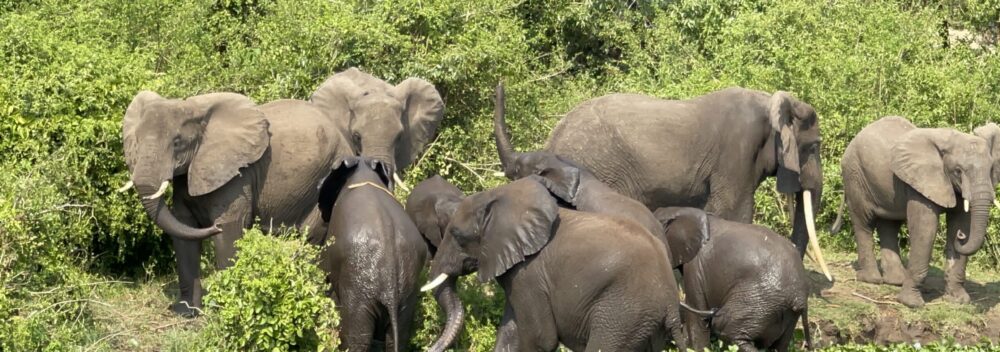
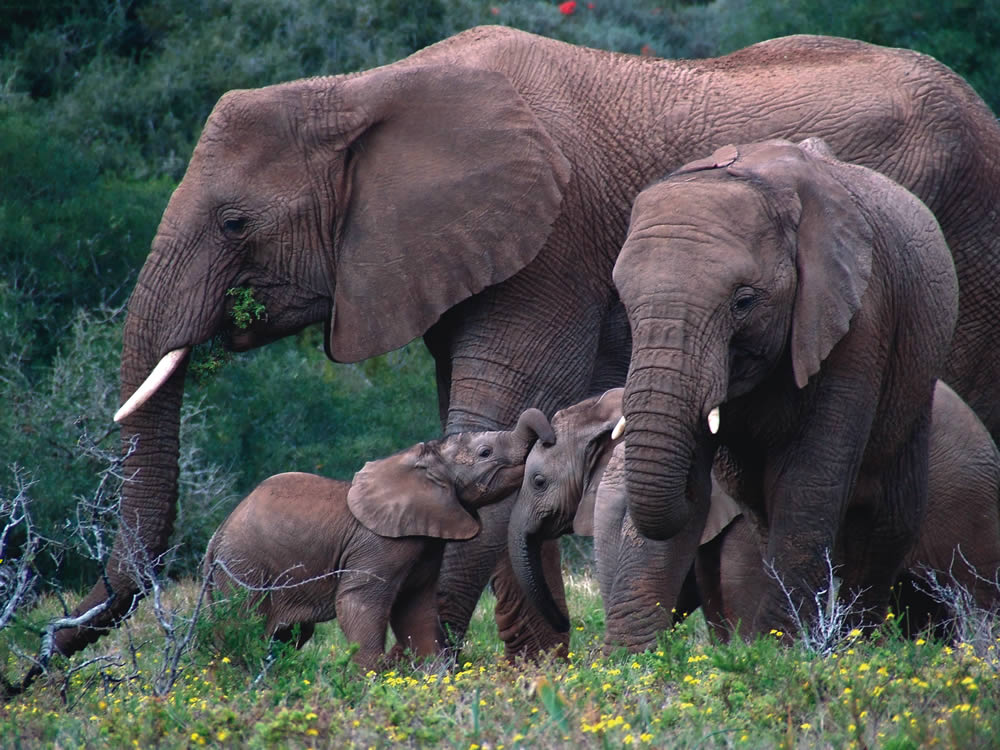
Today, the world is dealing with an unprecedented spike in illegal trade in wildlife and their parts. The increased demand for wildlife and their parts in some parts of the world has fueled the crime. The need to satisfy the demand for wildlife has sent some wildlife species especially on the African continent into total extension while others are on their way to extinction.
The world has continued to witness seizures of different wildlife parts that are traded in by wildlife traffickers. In Uganda, on March 18th, 2020, fourteen men of Chinese nationality were found at Kireka-Kamuli, Lubawo Zone, Kireka Municipality, in Wakiso district of Uganda, in illegal possession of wildlife species which included 10 pieces of dried elephant penises valued at over Uganda shillings 17 billion, pangolin scales and live tortoises. The men were charged in the Uganda wildlife court.
There is a need to take a deliberate step to end this kind of impunity. African animals must be safe in the wild!
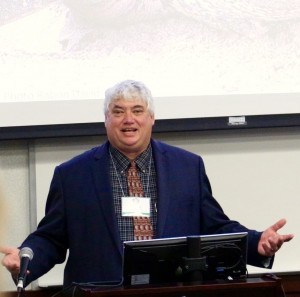
Animal Law LLM Candidate, Gladys Kamasanyu and Professor Russ Mead
The Center for Animal Law Studies (CALS), home to the Animal Law Program, and animal law projects and activities of Lewis & Clark Law School, interviewed the founder of Help African Animals with her Professor that mentored her through the formation of the organization.
Help African Animals is glad to be approved by the Internal Revenue Services (IRS) for the 501(c)(3) tax-exempt status. Support us to protect African animals. Earn yourself a tax deduction. https://twitter.com/CALSAnimalLaw/status/1260653345959636992
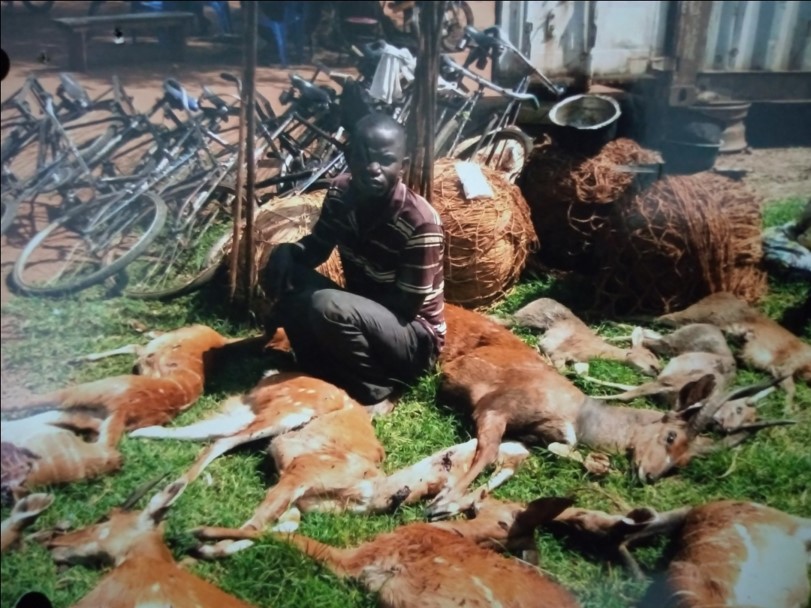
A hunter with carcasses of bushbucks and duikers, rolls of hunting nets and spears at Nakaseke – Uganda
Ignorance of the laws protecting wildlife and the importance of protecting wildlife among the general public in Uganda is costing many African Animals their dear lives.
Uganda’s wildlife is under serious threats of poaching. The threat is sending many of the wildlife species into total extinction. In Uganda, there are hunters who move from village to village in rural areas hunting and killing any wild animal. The poaching is done for food and also commercial purposes.
The captioned photo is of a hunter who was arrested in 2019 after he with others killed over 10 bushbuck and duikers in Nakaseke district. He was also in possession of rolls of hunting nets and spears all of which are devices used for injuring or killing wildlife. The rest of his colleagues ran away but he was arrested while he also tried to disappear.
The group also had bicycles which they used for transport and utensils which they used for cooking while in the bush hunting.
Lack of awareness about the laws protecting wildlife and the importance of conserving wildlife among the general public is a leading cause of poaching.
Raising awareness among the public will save the lives of innocent African animals who are brutally murdered.
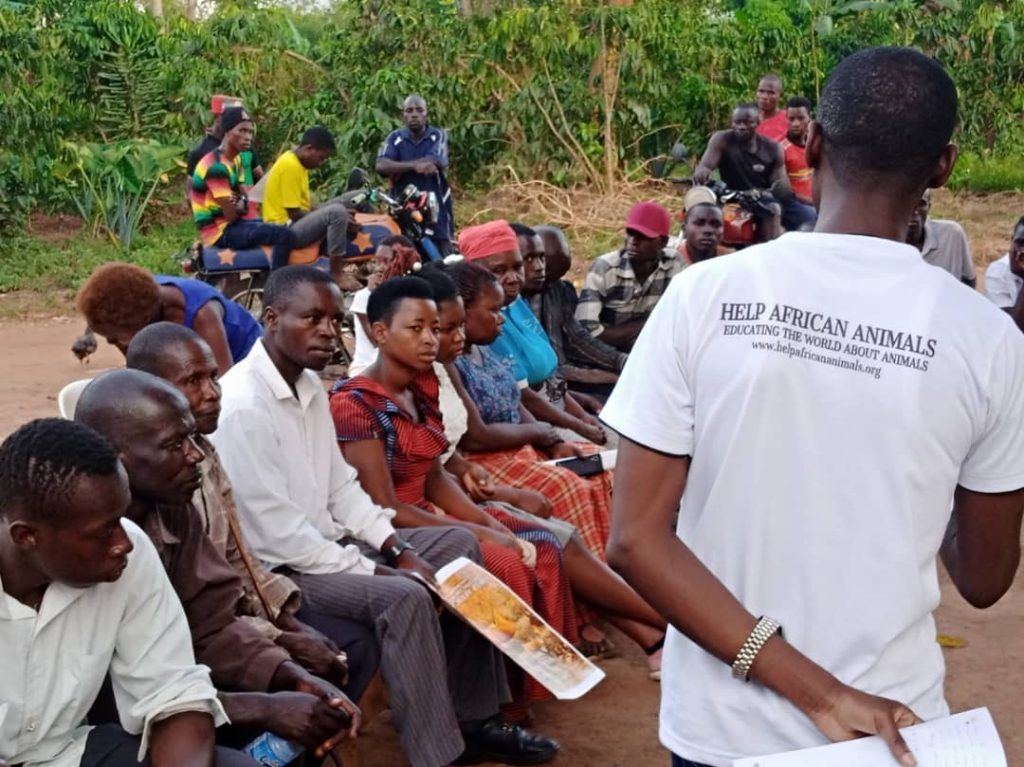
A volunteer of Help African Animals educating rural people in a Community Wildlife Talk held at Kapeeka sub-county, Nakaseke district of Uganda
In Uganda, rural people and animals live in the same ecosystem. The struggle for space and food between animals and humans is still a huge problem in Uganda. With all the dangers associated with living with wildlife, people regard wildlife as enemies which they must eliminate. Rural people are ignorant of the importance of conservation and the laws protecting wildlife. Out of ignorance, they kill animals which has sent many species of wildlife into extinction.
Rural people are also increasingly used by traffickers in the illegal wildlife trade. They are paid to kill the animals or used in the transportation of the protected species within the country and across borders. Rural people benefit less from illegal wildlife trade because they do not know the value of wildlife. Sadly, they are the ones who many times end up being arrested with the species and charged. They are shocked to learn that the species they killed/possessed are highly endangered/protected and that the offenses attract penalties of up to life imprisonment.
Having different individuals in the community to attend the education campaign was a great idea. Community members had a chance to learned that wildlife on their land or in their community is not theirs to kill/eat/destroy. They learned the importance of protecting wildlife, how to protect wildlife in their community, to identify wildlife crime and report it, the laws protecting wildlife, and penalties for violation of the laws.
Help African Animals is driven by the belief that unless people understand the dangers of killing/destroying wildlife, they will not care to conserve it and unless they care, they won’t help to support or participate in conservation efforts/programs. Animals don’t speak. Let us speak for them.